
Silverdale Previous-Resident Sources
A backward address trail changes source as it crosses each records era. Modern parcel and recording systems offer direct fields. Older searches depend on microfilm, printed volumes, archive indexes, and staff requests. The table keeps the source, span, keeper, and claim distinct.
| Source | Years it covers | Where held | What it shows |
|---|---|---|---|
| Assessor details | Current and prior assessment years online | Kitsap Assessor | Taxpayer, site/mail address, parcel and value clues |
| Recorded-document index | January 1987 to present | Kitsap Auditor | Modern transfer parties and documents |
| General Recordings Index | 1853–1971 | Puget Sound Regional Archives | Earlier grantor and grantee leads |
| Property cards | 1937–1972 | Regional Archives | Historic parcel context |
| Kitsap directories | Scattered runs, 1882–1984 | State Library and archives | Dated name/address leads |
| Territorial/state census | 1857, 1860, 1871, 1883, 1885, 1887, 1889 | Digital and Regional Archives | Household and demographic fields |
| Federal census | Public releases through 1940 in research | NARA and library databases | Household at enumeration date |
| DCD permits | Electronic from 2018; broader from 2020 | Kitsap DCD | Site and project changes, not occupants |
Start with the source closest to the target date. A deed chain is best for title. A directory or census is better for occupancy. If the question begins with the building, parcel cards and permits may show when the site changed.
Start at the Silverdale Parcel
Enter the current situs address in Kitsap Parcel Details. Save the parcel or account number, legal description, taxpayer, site address, mailing address, value year, and map link. If the exact address misses, omit the direction and road type, search the street name, and use the GIS map to choose the parcel. Situs is the property location; mailing is the tax correspondence destination.
The assessor is a lead, not the deed. Kitsap explicitly says taxpayer of record does not convey ownership. A trust, estate, business, or absentee taxpayer can appear, and an older name may remain during an update. Preserve it as the first search name, then test title against the Auditor’s instrument.
Note: The legal description usually survives longer than a street number and is the safest bridge into an older deed index.
Reverse the Kitsap Deed Chain
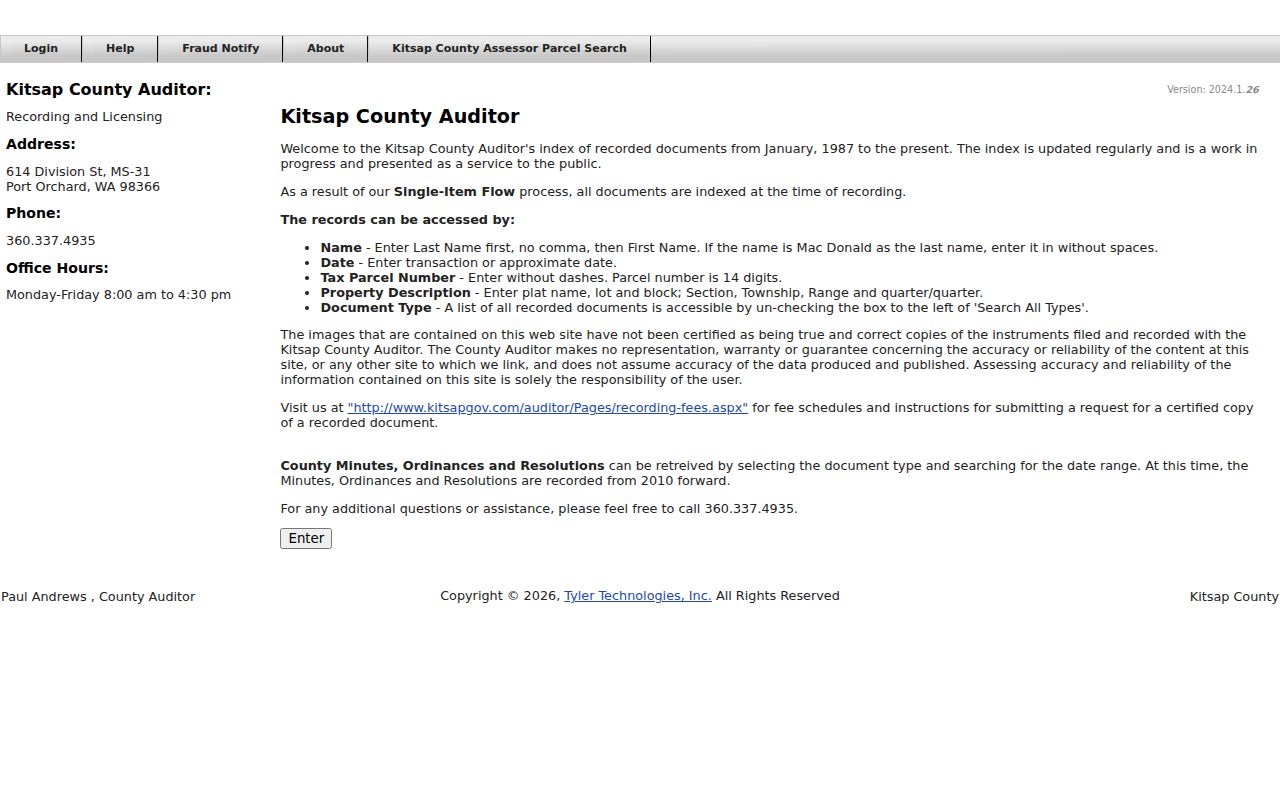
The Kitsap Auditor recorded-document index is the main modern path for previous residents who owned the property. It searches names, dates, parcel numbers, property descriptions, and document types. Enter last name first without a comma. Use spacing and initial variants. Narrow by a deed type, date, parcel, plat and lot, or section, township and range when names repeat.
- Find the current taxpayer and legal description in the assessor record.
- Locate the current purchase or transfer instrument in the Recorder index.
- Read the current holder as grantee and the seller or prior holder as grantor.
- Search that seller as a grantee in an earlier period, holding the legal description constant.
- Repeat until January 1987, then request the older book, microfilm, or index lead.
- Grantor
- The party transferring an interest in a recorded instrument.
- Grantee
- The party receiving that interest.
- Chain of title
- The linked sequence of recorded transfers for the same land.
- Legal description
- The plat-and-lot or survey-based identity of land, not its mail address.
A deed may name trustees, lenders, or other roles besides buyer and seller. Record the document type and party role. The index image is uncertified. The Auditor form accepts record number, grantor/grantee, year, type, and legal-description details; copies are $1 per page, while certification costs $3 for the first page and $1 for each additional page.
The official portal view below shows the interface used to build the backward chain.
When Silverdale Deeds Leave the Web
The public Recorder index starts in January 1987. Puget Sound Regional Archives lists a General Recordings Index from 1853–1971 and property cards from 1937–1972. Research did not confirm a single continuous online or archival route for 1972–1986. Ask the Auditor or archives for that span rather than silently filling it.
Recording services are also available by mail and through the Auditor’s Port Orchard office at 614 Division Street MS-31. The office number is 360-337-4935, and posted weekday hours are 8:00 to 4:30. For older Kitsap material, contact the Puget Sound Regional Archives. Branch material lists 425-564-3940 and psbrancharchives@sos.wa.gov for series, image, reproduction, and microfilm questions.
Some early territorial court and probate originals were apparently destroyed after filming. The surviving microfilm can be poor. Compare its index and image, ask whether another reproduction exists, and mark an uncertain reading instead of completing a name from guesswork.
Repair a Silverdale Address Break
Silverdale sits in unincorporated Kitsap County, where DCD assigns and corrects addresses under a six-district grid. Road naming, subdivisions, short plats, and corrections can all change the string printed in a later source. The Central Area road map documents changes from October 2014 to October 2015 around roads such as Silverdale Way, Anderson Hill, Newberry Hill, Bucklin Hill, and Ridgetop.
The county Address History Report supplies bridge evidence. On parcel 102501-3-005-2003, sampled Swantown rows change 11451 NW Swantown Street to 11439 and 11453 to 11441. Another queried address returns “NONE FOUND.” Preserve both outcomes. Search the old and new strings, then confirm that they point to the same parcel.
This quirk matters more than spelling polish. Replacing an old number without citing the county report can attach the wrong previous residents to a house. Store the source form, the normalized form, the report date, and the parcel key as separate facts.
Match Silverdale Households Across Years
Owners are only part of the story. Printed directories, census schedules, obituaries, and yearbooks can identify people associated with the address who never held title. State Library Kitsap directory runs are scattered from 1882 to 1984. The regional archive lists Polk runs from 1914–1915 through 1948–1983, and an established catalog lists Silverdale-specific volumes for four runs between 1913 and 1921.
- Choose the directory year nearest the known deed or family date and search both the current and historic road form.
- Copy each same-address entry exactly, including initials, page, year, and any notation actually printed.
- Pair it with the nearest released census schedule, but keep the two citations separate.
- Use an obituary, probate file, school yearbook, or newspaper to explain a transition only when it names the relationship or place.
- Move one date backward and repeat. Absence from one volume is not proof that a person moved or died.
A census reports the household in its enumeration geography. A directory reflects its own canvass and publication cycle. Their dates can differ, and modern Silverdale boundaries do not map neatly to historic county, township, settlement, rural-route, or post-office labels. The Silverdale directory book page covers the collections themselves; this workflow uses them only to test one address.
Ask Silverdale Genealogy Partners
No dedicated Kitsap house-history guide was located. The practical local substitute is Kitsap Regional Library genealogy service with the Puget Sound Genealogical Society. Available routes include obituary and genealogy-item requests, microfilm, yearbooks, Ancestry Library, and FamilySearch. Ask for an exact volume and call number, and whether it is print, microfilm, fiche, or scan.
The successful capture below shows that official local-history entry point.
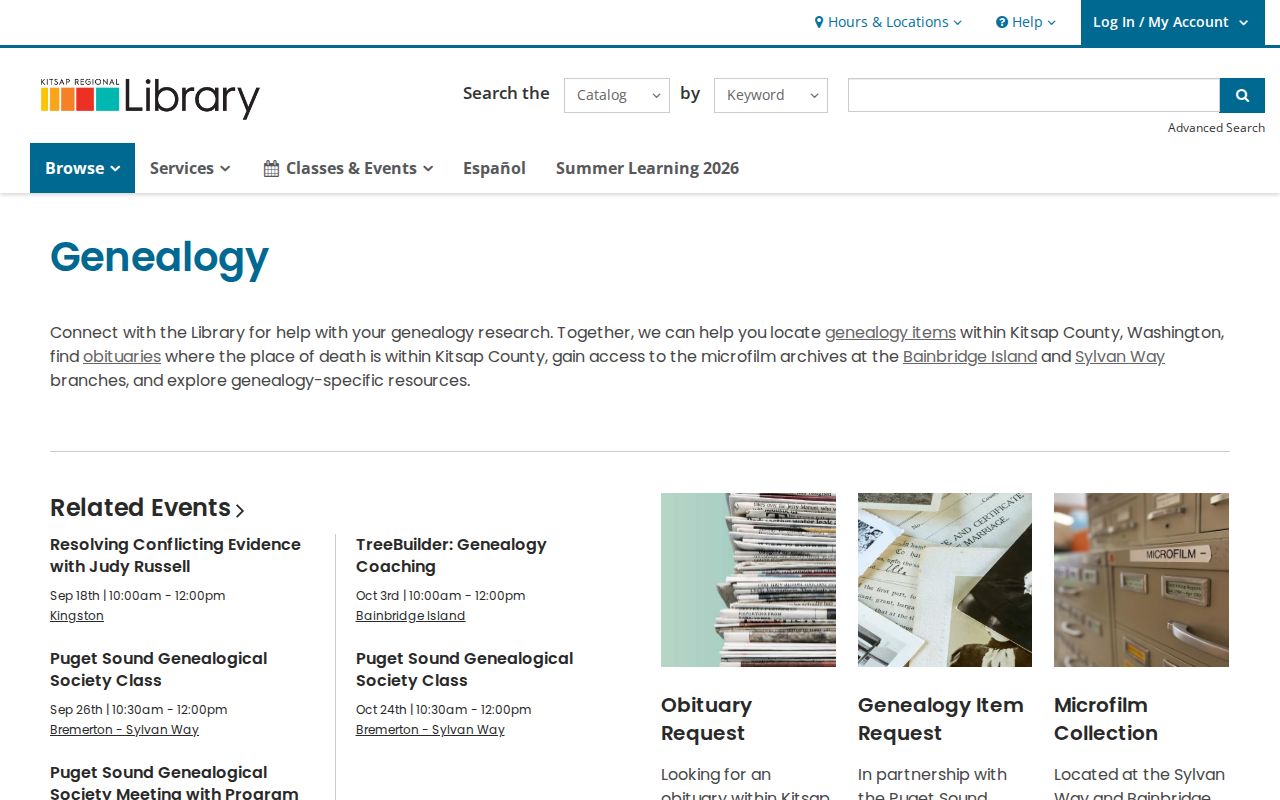
The Silverdale Library can refer patrons to the right local resource. KRL’s 2025 Scan EZ launch also lets Silverdale patrons preserve fragile photos or newspaper pages as JPG or PDF files. Record the scan’s source, date, publication, and page so a useful image does not lose its context.
Date Silverdale Changes With Permits
Kitsap DCD records can date a building, addition, subdivision, land-use action, environmental review, code matter, or fire record tied to an address or parcel. Submitted electronic permits begin in 2018. Approved building and submitted land-use or development coverage becomes more complete from 2020. Earlier records depend on retention and a request.
Search SmartGov and the Permit Activity Map by parcel or address. Record the permit number, type, site, dates, and project text. Map-click, Near Me, and Screening tools can add nearby context. An applicant, contractor, architect, or agent is not automatically an owner or occupant.
When a portal search misses, describe the address, parcel, record type, and date range in the DCD Public Records route. Washington’s Public Records Act process generally calls for an agency response within five business days by providing records, acknowledging the request and estimating time, or denying it with a stated exemption.
Use Maps Without Inventing Residents
Sanborn fire-insurance maps can date building footprints and uses, but research found no Silverdale-specific Sanborn item. The nearest documented Library of Congress example is a seven-sheet 1904 Bremerton map. It may explain nearby Kitsap building context, but it must never be relabeled as a Silverdale map or used as an occupant list.
Likewise, a property card can bridge a tax era without proving a deed. A general recording index may supply a book and page without an online instrument. A directory may tie a name to an address but not a transfer date. Label each record by what it is, then ask the keeper for the missing document.
For the earliest trail, the Washington Digital Archives 1857 Kitsap census has indexed images with names, ages, birthplaces, occupations, citizenship, and remarks. Search Kitsap and the former Slaughter County name. That collection predates modern Silverdale streets, so county and settlement geography matter more than today’s address.
Close Silverdale Previous-Resident Gaps
An obituary can connect a former address with a spouse, child, organization, or date. A probate file can name heirs, a personal representative, property, and notices. Puget Sound holdings list Kitsap probate indexes for 1853–1977 and cause files for 1853–1971; modern Superior Court files route through the Kitsap Clerk, Digital Archives, or Odyssey as access permits.
KRL offers obituary help. Established genealogy research lists the Silverdale Breeze for 1945–1967 and Central Kitsap Reporter for 1999–2016, though exact run access varies. Cite the publication and date. Do not use a decades-old obituary to infer anyone’s present address.
Lawful use. Research previous residents for house history, genealogy, estate work, or personal curiosity, never to track or pressure a living person.
Washington’s Address Confidentiality Program protects actual location data for eligible participants. A substitute address is not a puzzle to solve. Stop any backward trail that would expose a protected current location, and verify important historical claims with the record custodian.